
Every hotel has an address; this one has a coordinate. Park Hotel Shanghai (上海国际饭店) opened on 1 December 1934 as the Joint Savings Society Building — funded by four Chinese banks, designed by the Hungarian-Slovak architect László Hudec, and built to be a statement: 24 storeys and 83.8 metres of American-inspired Art Deco that made it the tallest building in all of Asia, a title it held for decades.
The architect and the skyscraper
Hudec — a First World War prisoner who escaped Siberia and rebuilt his life in Shanghai — drew inspiration from his 1920s visits to New York, and the stepped silhouette shows it: dark brown brick, vertical lines, a crown that narrows floor by floor into the sky. Locals coined an idiom for it — look up, hat off. A young I.M. Pei, watching the tower rise from the neighbourhood, later credited it as the moment he decided to become an architect.
The zero point
In 1950, Shanghai’s land administration chose the hotel’s rooftop flagpole as the origin of the city’s coordinate system — the zero from which every bridge, metro line and navigation chart in Shanghai is measured. A bronze plaque set into the lobby floor marks it today, which makes the hotel the only address in China that is, officially, the centre of its own city. Shanghai has updated its coordinate system since; the zero point never moved.
The guest list
The 1930s brought Charlie Chaplin — hosted at a banquet by Peking Opera master Mei Lanfang and film star Hu Die. The postwar decades brought mayors, delegations and the 1947 wedding of General Claire Lee Chennault and journalist Chen Xiangmeu on the 14th floor. The hotel even helped launch transpacific telephony in 1937, when the first wireless call between Shanghai and North America was placed from its floors.
Heritage, kept alive
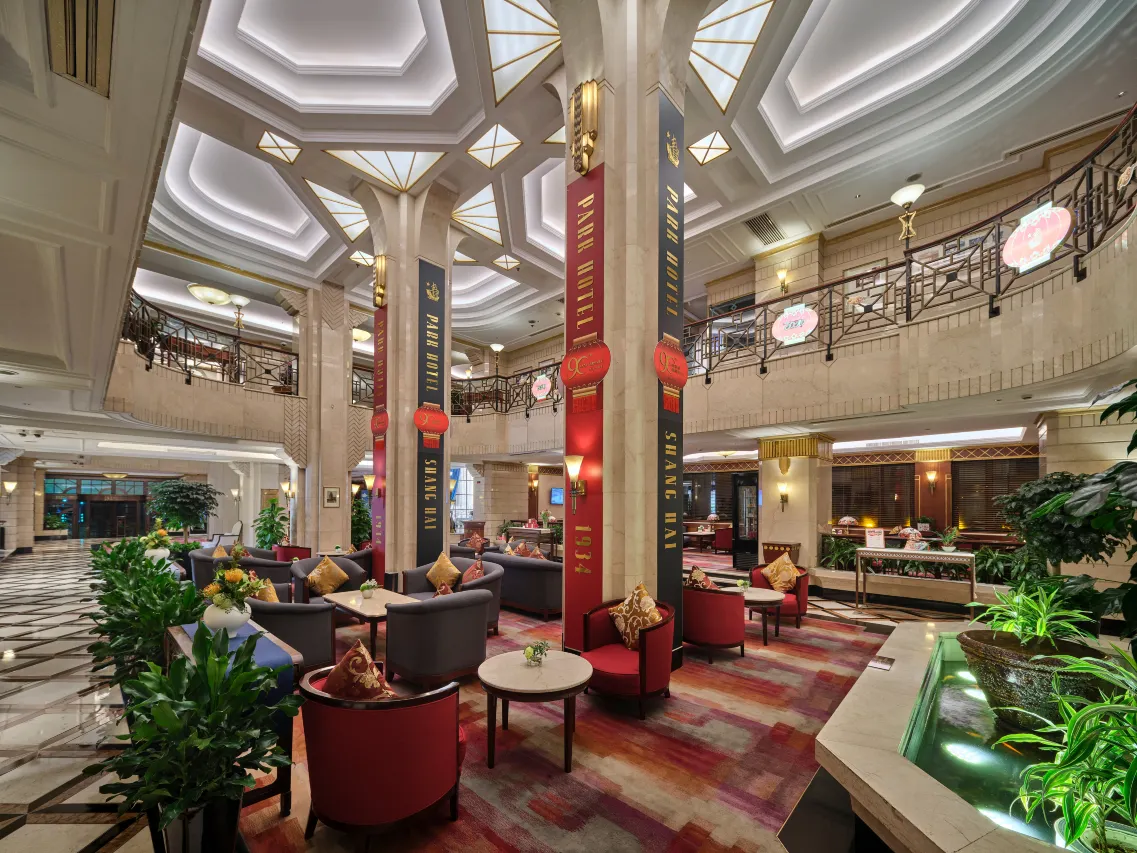
Listed as a National Key Heritage Site in 2006 and renovated in 2009, the hotel keeps its history where guests can touch it — the lobby plaque, the history gallery with Hudec’s drawings, the 14th-floor banquet halls — and its traditions where they can taste it: the butterfly pastry bakery on Huanghe Road, whose daily queue is as much a Shanghai landmark as the tower above it. Whether you come for one night or a week, welcome to the centre of Shanghai. Look up, hat off.